

Clean Core Strategy: Unlocking AI for South African ERP Systems
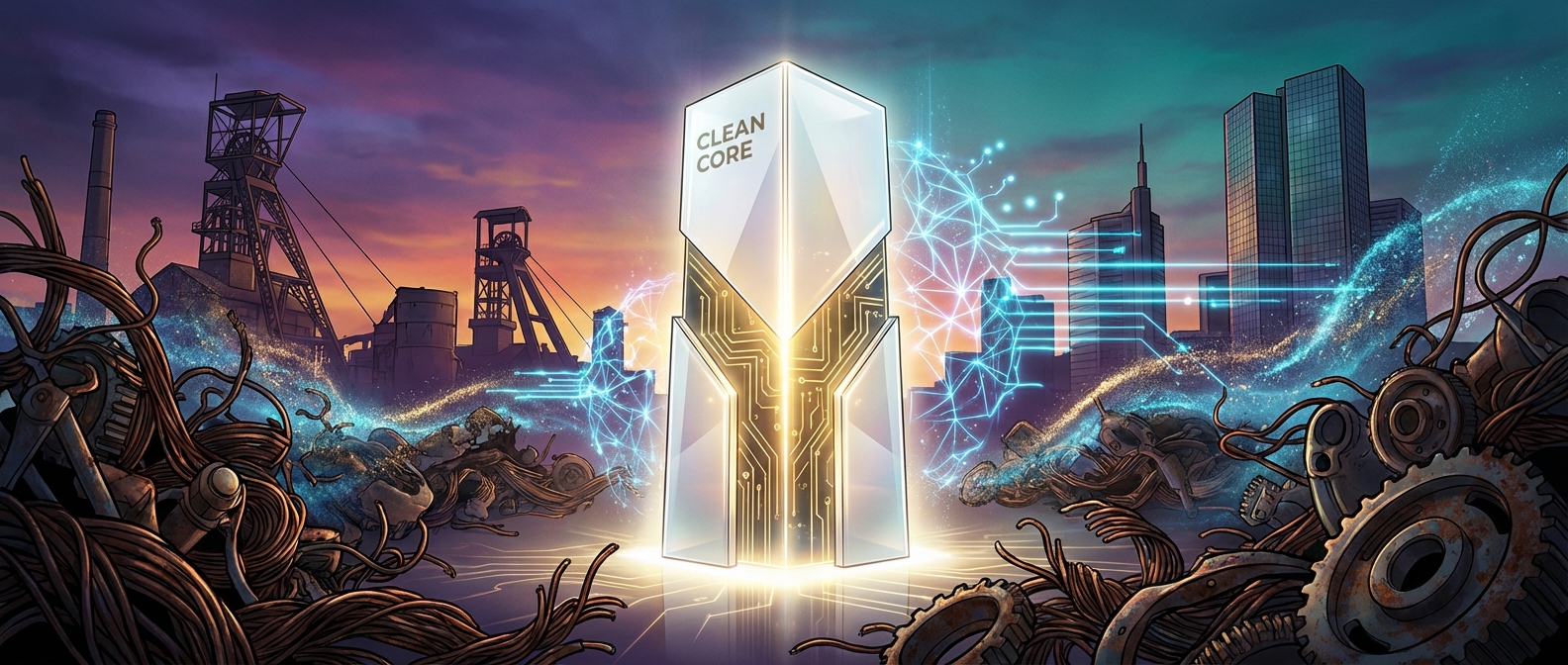
Learn how South African enterprises are using the Clean Core strategy to decouple legacy customizations, reduce technical debt, and prepare for AI-driven ERP modernization.
For decades, South African enterprises across mining, manufacturing, and financial services have relied on heavily customized Enterprise Resource Planning (ERP) systems to manage their complex operations. These monolithic structures, often built on legacy versions like SAP ECC 6.0, were once viewed as a competitive advantage. However, as the global economy pivots toward Artificial Intelligence and real-time data processing, these highly bespoke environments have become significant technical debt traps. Recent data from SAP Africa indicates that while the local ERP market is set to expand at a compound annual growth rate of 14.9% through 2030, many organizations are finding that their legacy customizations are now the primary roadblock to innovation. Specifically, as 67% of large South African enterprises have already begun adopting Generative AI as of 2025, the need to modernize the underlying ERP foundation has reached a critical tipping point.
The challenge for the typical South African business owner or CIO is that legacy ERP systems are often 'contaminated' with thousands of lines of custom ABAP code and undocumented modifications. This 'spaghetti logic' makes it nearly impossible to upgrade to modern, AI-ready platforms like SAP S/4HANA Cloud or Microsoft Dynamics 365 without massive risk and expense. In fact, industry analysts at Gartner and IDC estimate that by 2027, 70% of ERP transformation failures will be attributed to the underestimation of legacy complexity and technical debt. For a South African company navigating a volatile economy and infrastructure challenges like load shedding, these multimillion-rand transformation failures are not just IT setbacks—they are existential threats to business continuity.
Enter the Clean Core strategy. This methodology fundamentally shifts how enterprises handle customizations. Instead of modifying the core ERP code, the Clean Core approach advocates for keeping the standard software stack pristine and moving all unique business logic to a separate, 'side-by-side' platform. For SAP users, this primary vehicle is the SAP Business Technology Platform (BTP). By leveraging tools like SAP Build and ABAP Cloud, developers can create extensions that interact with the ERP through stable, released APIs. This decoupling ensures that the core system remains upgrade-safe, allowing for the frequent, non-disruptive updates required to maintain modern security and performance standards.
The most compelling reason for South African enterprises to adopt a Clean Core strategy is the immediate enablement of AI. Modern AI agents and predictive analytics require clean, governed, and connected data to function effectively. Legacy systems, with their fragmented data structures and hard-coded integrations, often provide 'dirty' data that leads to AI hallucinations or failed automation workflows. When the core is clean, data remains standardized, and AI tools like SAP Joule or Microsoft Copilot can be seamlessly integrated to provide real-time insights. For example, a Gauteng-based manufacturing firm recently leveraged an AI-driven inventory management solution integrated with a modernized ERP core to reduce stockouts by 25% and increase overall revenue by 10%. This level of agility is impossible when the business logic is buried inside a rigid, legacy core.
Implementing a Clean Core strategy requires a disciplined 'Fit-to-Standard' mindset. This means that during a modernization project, the default answer to a customization request should be to use the standard process provided by the software vendor. Business leaders must empower their teams to rethink processes rather than forcing the software to mimic outdated, manual workflows. This cultural shift is perhaps the most difficult part of the journey. To manage this, many South African firms are establishing Clean Core governance boards that include both business and IT leaders. These boards ensure that any necessary extensions are built using modern, decoupled frameworks like the Cloud Application Programming (CAP) model or low-code tools, ensuring long-term maintainability.
Furthermore, the timeline for this transition is no longer a distant concern. With SAP's maintenance deadline for legacy ECC systems fast approaching in 2027 (and 2030 for some extended support options), the window for strategic planning is closing. South African enterprises must decide whether they will incrementally patch their legacy systems or 'leapfrog' directly to modern, cloud-native platforms. Those who choose the latter, backed by a Clean Core strategy, will find themselves at a distinct advantage. They will be able to adopt new business models faster, integrate with regional supply chain partners more easily, and leverage the full power of AI to drive operational efficiency.
As you begin this journey, it is essential to partner with experts who understand the nuances of the South African business landscape and the technical requirements of modern ERP architecture. At WriteNow Agency, we specialize in helping organizations navigate these complex transitions by providing the technical expertise needed to decouple legacy systems and build future-proof, AI-driven solutions. Modernizing your ERP is not just a technical upgrade; it is a strategic repositioning of your entire business for the intelligence age. By embracing a Clean Core strategy today, South African enterprises can transform their ERP from a maintenance-heavy cost center into a powerful engine for innovation and growth.
The challenge for the typical South African business owner or CIO is that legacy ERP systems are often 'contaminated' with thousands of lines of custom ABAP code and undocumented modifications. This 'spaghetti logic' makes it nearly impossible to upgrade to modern, AI-ready platforms like SAP S/4HANA Cloud or Microsoft Dynamics 365 without massive risk and expense. In fact, industry analysts at Gartner and IDC estimate that by 2027, 70% of ERP transformation failures will be attributed to the underestimation of legacy complexity and technical debt. For a South African company navigating a volatile economy and infrastructure challenges like load shedding, these multimillion-rand transformation failures are not just IT setbacks—they are existential threats to business continuity.
Enter the Clean Core strategy. This methodology fundamentally shifts how enterprises handle customizations. Instead of modifying the core ERP code, the Clean Core approach advocates for keeping the standard software stack pristine and moving all unique business logic to a separate, 'side-by-side' platform. For SAP users, this primary vehicle is the SAP Business Technology Platform (BTP). By leveraging tools like SAP Build and ABAP Cloud, developers can create extensions that interact with the ERP through stable, released APIs. This decoupling ensures that the core system remains upgrade-safe, allowing for the frequent, non-disruptive updates required to maintain modern security and performance standards.
The most compelling reason for South African enterprises to adopt a Clean Core strategy is the immediate enablement of AI. Modern AI agents and predictive analytics require clean, governed, and connected data to function effectively. Legacy systems, with their fragmented data structures and hard-coded integrations, often provide 'dirty' data that leads to AI hallucinations or failed automation workflows. When the core is clean, data remains standardized, and AI tools like SAP Joule or Microsoft Copilot can be seamlessly integrated to provide real-time insights. For example, a Gauteng-based manufacturing firm recently leveraged an AI-driven inventory management solution integrated with a modernized ERP core to reduce stockouts by 25% and increase overall revenue by 10%. This level of agility is impossible when the business logic is buried inside a rigid, legacy core.
Implementing a Clean Core strategy requires a disciplined 'Fit-to-Standard' mindset. This means that during a modernization project, the default answer to a customization request should be to use the standard process provided by the software vendor. Business leaders must empower their teams to rethink processes rather than forcing the software to mimic outdated, manual workflows. This cultural shift is perhaps the most difficult part of the journey. To manage this, many South African firms are establishing Clean Core governance boards that include both business and IT leaders. These boards ensure that any necessary extensions are built using modern, decoupled frameworks like the Cloud Application Programming (CAP) model or low-code tools, ensuring long-term maintainability.
Furthermore, the timeline for this transition is no longer a distant concern. With SAP's maintenance deadline for legacy ECC systems fast approaching in 2027 (and 2030 for some extended support options), the window for strategic planning is closing. South African enterprises must decide whether they will incrementally patch their legacy systems or 'leapfrog' directly to modern, cloud-native platforms. Those who choose the latter, backed by a Clean Core strategy, will find themselves at a distinct advantage. They will be able to adopt new business models faster, integrate with regional supply chain partners more easily, and leverage the full power of AI to drive operational efficiency.
As you begin this journey, it is essential to partner with experts who understand the nuances of the South African business landscape and the technical requirements of modern ERP architecture. At WriteNow Agency, we specialize in helping organizations navigate these complex transitions by providing the technical expertise needed to decouple legacy systems and build future-proof, AI-driven solutions. Modernizing your ERP is not just a technical upgrade; it is a strategic repositioning of your entire business for the intelligence age. By embracing a Clean Core strategy today, South African enterprises can transform their ERP from a maintenance-heavy cost center into a powerful engine for innovation and growth.

Comments (0)
Leave a Comment