

Automating Carbon Accounting for SA Manufacturers Under CBAM 2026
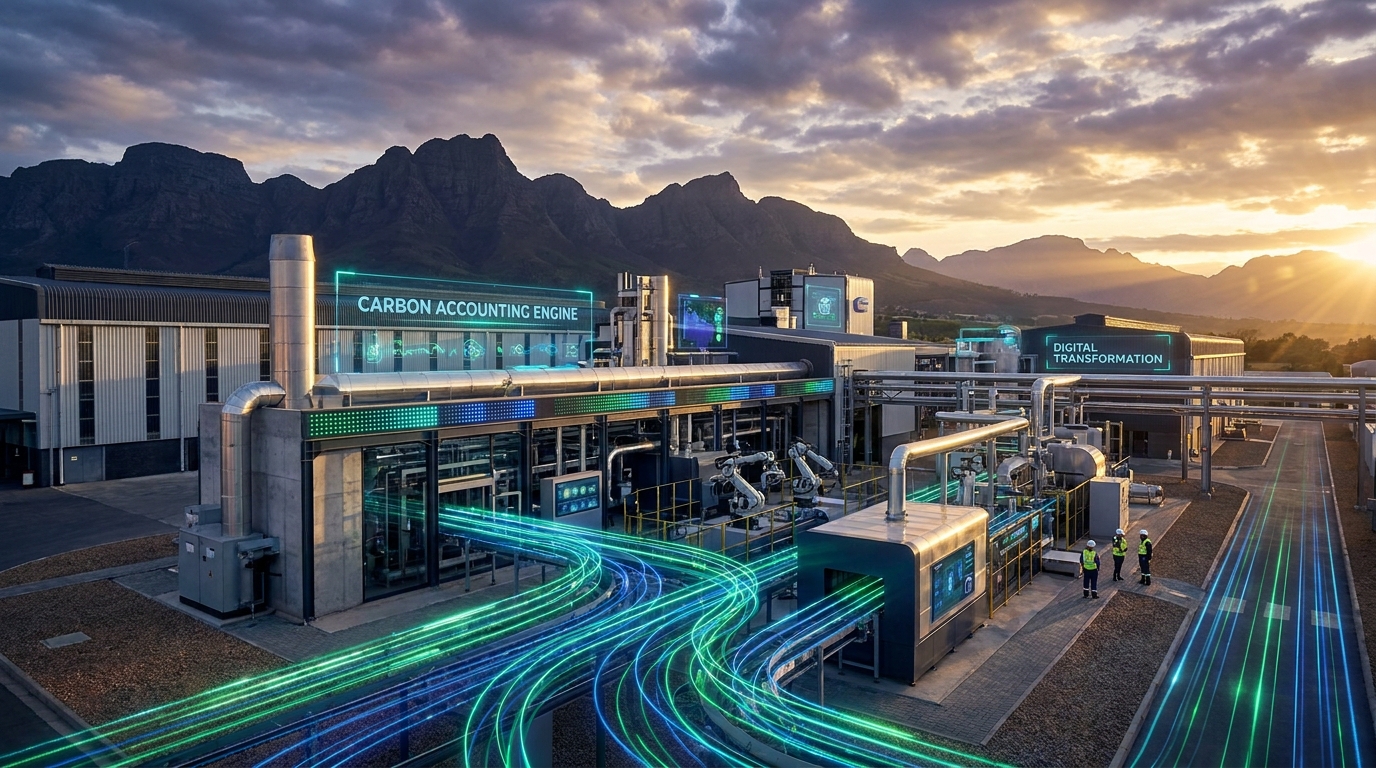
Discover how South African manufacturers can leverage automated carbon accounting engines to navigate the 2026 EU CBAM framework and protect export revenue.
The European Union’s Carbon Border Adjustment Mechanism (CBAM) is no longer a distant regulatory concept; it is a definitive fiscal reality that will reshape the landscape of international trade for South African manufacturers. As the world moves toward a net-zero economy, the EU has introduced CBAM to ensure that its own climate policies are not undermined by carbon leakage—the relocation of production to countries with less stringent emissions standards. For South Africa, a nation whose manufacturing sector is deeply integrated with European markets, the transition from the current monitoring phase to the full taxation phase on January 1, 2026, represents a critical turning point. Beyond the immediate threat of export taxes, this shift presents an opportunity for local businesses to modernize their operations through automated carbon accounting engines. The South African manufacturing sector is uniquely exposed to CBAM due to the high carbon intensity of our national power grid. With Eskom’s grid emission factor historically hovering around 0.9 to 1.0 kilograms of CO2 per kilowatt-hour, South African products often carry a significantly higher carbon footprint than their European counterparts. The sectors most immediately affected—iron, steel, aluminum, cement, fertilizers, and hydrogen—are the backbone of our industrial export economy. Companies like ArcelorMittal South Africa and major aluminum producers are already navigating the transitional phase, which began in October 2023. During this period, exporters are required to report embedded emissions on a quarterly basis, but no financial adjustments are yet applied. However, the deadline of 2026 marks the end of this grace period. From that point forward, exporters will be required to purchase CBAM certificates to cover the gap between the carbon price paid in the country of origin and the price of carbon in the EU Emissions Trading System (ETS). The primary challenge for South African entrepreneurs is the transition from manual, retrospective carbon reporting to real-time, automated accounting. For years, carbon footprints were calculated using static spreadsheets and annual utility bills. This approach is no longer sufficient under the rigorous verification standards of the EU. CBAM demands granular data that tracks emissions at the production installation level. Manual reporting is not only prone to human error but also lacks the auditability required by international verifiers. To remain competitive, manufacturers must build or implement automated carbon accounting engines that integrate directly with their existing infrastructure. An automated carbon accounting engine is a software layer that sits between a company’s operational technology and its financial reporting systems. The architecture typically begins with data ingestion, where the system pulls real-time information from Enterprise Resource Planning (ERP) systems like SAP S/4HANA, Oracle, or Sage 200. This is supplemented by Internet of Things (IoT) sensors installed on the factory floor to monitor energy consumption and raw material throughput at specific points of production. By capturing data at the source, businesses can move away from broad estimates and toward precise, batch-level carbon intensity metrics. Once the data is ingested, the calculation engine applies localized emission factors to convert raw activity data into CO2 equivalents. In South Africa, these factors must align with the methodologies prescribed by the Department of Forestry, Fisheries and the Environment (DFFE) and the Carbon Tax Act of 2019. The complexity arises when calculating Scope 3 emissions—those occurring in the supply chain. Automated engines can facilitate this by using APIs to connect with suppliers’ data portals, creating a transparent 'carbon ledger' that follows a product from raw material extraction to the point of export. Several global technology leaders have already released tools to assist with this transition. SAP’s Sustainability Control Tower and Microsoft’s Sustainability Manager provide robust frameworks for tracking ESG metrics. However, for many South African manufacturers, off-the-shelf global solutions require significant customization to account for local regulatory nuances, such as the specific structure of the South African carbon tax and the unique energy mix of our industrial zones. This is where custom software development becomes a strategic asset. A bespoke engine can be tailored to the specific production lines of a local foundry or chemical plant, ensuring that every kilowatt of solar energy generated on-site is accurately credited against the carbon footprint of the final product. The financial implications of failing to automate are substantial. The 'price gap' between the South African carbon tax—currently significantly lower than the EU ETS price—means that without accurate reporting, local firms could be hit with the full weight of the EU’s carbon price, which has frequently exceeded 80 to 100 Euros per tonne in recent years. By proving a lower carbon intensity through verified data, South African exporters can significantly reduce the number of CBAM certificates they are required to purchase. Furthermore, an automated system allows businesses to perform 'what-if' simulations, modeling the impact of switching to renewable energy sources or upgrading machinery before making capital investments. Beyond compliance, there is a powerful marketing and strategic advantage to be gained. As global supply chains prioritize sustainability, being able to provide a 'Digital Product Passport' that includes a verified carbon footprint can become a competitive differentiator. European buyers are increasingly looking for partners who can simplify their own Scope 3 reporting requirements. A South African manufacturer that can offer automated, transparent carbon data becomes a preferred partner, potentially securing long-term contracts over competitors who remain stuck in the era of manual reporting. As we approach the 2026 deadline, the window for digital transformation is narrowing. Building a robust carbon accounting engine is not a project that can be completed in a few weeks; it requires a deep integration of software engineering, environmental science, and business logic. At WriteNow Agency, we specialize in helping South African businesses navigate these complex technical integrations, ensuring that their systems are ready for the demands of the modern global market. The goal is to move beyond seeing carbon as a tax burden and start viewing it as a data-driven metric for operational efficiency. In conclusion, the CBAM framework should be viewed as a catalyst for the digital modernization of South African manufacturing. By moving away from spreadsheets and toward automated, integrated carbon accounting engines, local businesses can protect their access to the European market, reduce their tax liabilities, and position themselves as leaders in the burgeoning green economy. The future of trade is transparent, digital, and decarbonized. Those who invest in the right technological foundations today will be the ones who thrive in the global marketplace of 2026 and beyond.


Comments (0)
Leave a Comment